Header

Image Map

Sunday, February 19, 2017

3 Tips for Including Adult Students in Your Studio

Adult music students are my absolute favorite to have in my studio. For a while though, I didn't really consider the possibility of teaching adults. I thought that people often either did something in childhood or didn't and that usually dictated what they continued with beyond their schooling years. However, there's definitely a market for teaching adults. I've seen two different types of adult lesson seekers: those who have had a dream to learn an instrument their entire life and they're finally pursuing the dream OR those who played an instrument back in their school days and they want to relearn that instrument(I had one adult flute student who wanted to be able to play duets with her son who was starting to learn clarinet in middle school).


Adult Students are the best because...

1. They actually practice.
I don't know about you but I find that lessons are so much more pleasant when students practice. The great thing about adult students is that most of them actually want to practice. Unlike students who are sometimes encouraged to or forced to take lessons by their parents, adult students typically spend their own money on lessons to learn something new that they actually want to do.

2. They have fully developed attention spans and brains.
Don't get me wrong, I love teaching adorable 5 year olds. They're full of energy and excitement. But sometimes it can be exhausting to keep them on track. With adult students, they can easily stay focused for 30 or 60 minute lessons. I've found these lessons to be much less tiring.

3. They're...adults.
Sometimes it's nice to talk to another adult. While they likely won't make you a cute, thoughtful hand drawn memento for your desk, they speak your language. Oh, and they wash their hands, which is a huge plus when strep throat is making it's rounds.

3 Tips for Teaching Adult Students

1. Make sure you have a method book for adults.
Many method books have bright colors, cartoons, or language for children. While that's great for your younger students, your adult students will definitely appreciate an adult looking book. Make sure you have some method books to recommend. For piano students, I use Alfred's Adult All-In-One Piano Book and for flute students, I use 
Rubank's Flute Beginner Method Book(their beginner book is called "elementary" but the word elementary is used in the sense that it is simpler or easier and not that it is geared towards elementary aged students). 
 

Please note, these links are affiliate links but are the books I use in my actual studio.

2. Do a pre-lesson assessment of their musical skills.
It is really important to ask questions about prior musical experiences with adult beginners. Initially one of my adult students told me that she can't read or play. After asking her some questions, I found out that she actually played flute for three years in middle school and thought she didn't remember anything. She thought wrong by the way - although rusty at first, she quickly began remembering how to play flute and read music and was able to progress much quicker than a true beginner. Knowing this experience changed my approach to teaching her and allowed her to progress further.

Some questions to consider:
  • Have you ever played any instruments?
  • Were you involved in band, choir, orchestra, or any other ensembles?
  • Have you participated in a church choir or church band?
  • Can you read any rhythms or music notes?
3. Find your student's dream music.
A lot of times, your adult student has a dream song or piece of music that they'd always wished they could play. Because they don't have a school ensemble or contest to keep them interested and motivated, I use this dream music as a way to keep them engaged. I have them pick out a few pieces or songs and see if we can include a small chunk into each week's lesson. Right now, one of my student's is working on a Cristofori's Dream, a piece he's always dreamed of playing(ha..ha...ha?).

So tell me, do you have adult students in your studio? What do you love about teaching adult students and what are your challenges?


post signature

Thursday, December 15, 2016

Stress Relief Tips for the Music Teacher

Being a music teacher can bring a lot of stress. From teaching classes(sometimes to the entire student population) to putting spectacular performances, it's definitely easy to feel the pressure. Check out these tips for relieving stress and keeping calm.

Being a music teacher can bring a lot of stress. From teaching classes(sometimes to the entire student population) to putting spectacular performances, it's definitely easy to feel the pressure. Check out these quick tips for relieving stress and keeping calm.


Find a Happiness 9-1-1 Song
This is a tip from one of my favorite podcasts, Happier with Gretchen Rubin. In one of her episodes, she suggests finding a song that will give you a little pick me up when you hear it. It might be an upbeat Top 40 song or a nostalgic song that brings you back. This can be a go to song or playlist to play on your way home from a rough day or during a break to get you through the rest of the day. Need some inspiration? There's a pre-made Spotify playlist from the podcast!

Take a Short Guided Meditation Break
Meditation has so many benefits. At first, I was intimidated by meditation. I had always envisioned meditation consisting of someone sitting by themselves on a hard surface for a very, very long time. It doesn't have to be that way! I use a wonderful app on my phone called Meditation Studio. The first course breaks down how to meditate in easy 5-10 minute chunks. After completing the starter course, you can choose guided meditations that focus specifically on stress relief that can be as short as 2 minutes. This can be a perfect break in between classes or at lunch to de-stress.

Keep a Pick Me Up Box
Find or purchase a box and fill it with good memories of your teaching career. I recommend plastic since it will hold up a little better rather than a cardboard box. Fill it with student notes or drawings, print out positive parent emails, favorite concert programs, pictures of music making, and anything that will bring a smile to your face. It's great to have the reminder of what I do what I do, especially after a receiving a tough email or having an observation that didn't go exactly as planned. I also put some of my favorite chocolate in my box. You may even want to add a small gift card to your favorite coffee shop to use "in case of emergency" for those extra stressful days.

How do you stay calm during stressful days? Comment below!

post signature

Thursday, October 27, 2016

Rhythm & Poetry

Cross curricular activities are great. But sometimes it's tough to marry two subject areas evenly. While using songs to teach addition, grammar, and other concepts is helpful for students, it may not truly be teaching or reinforcing musical concepts. Incorporating rhythm and poetry into a lesson can give both subjects equal attention.

Marry rhythm and poetry together into one activity with rhythm haikus. These fun, easy poems are a great opportunity to incorporate cross curricular activities into the music classroom.


I like to use haiku poems. They are fun, fairly easy to write, and come with a rich history. Students may even be learning about them in their reading class! A haiku is a traditional Japanese poem written in a 5-7-5 syllable pattern. When translating this into music, I use one syllable=quarter note and two syllables=eighth notes. 


Pick a topic that you want your students to write about. Depending on the grade level and student ability you may choose to provide them with a word list or you may want to brainstorm words with students and categorize them into 1 or 2 syllable words. To help students determine how many syllables a word has, I have them place their hand under their chin and count the number of times their chin taps their hand while they say the word. If a word has more than 2 syllables, you may consider discarding it or fitting it across 2 rhythms (e.g. butterfly as 2 eighths and a quarter). 

Guide students through the haiku 5-7-5 pattern and give them time to work on their own. After writing their poem, students can practice saying the rhythms and/or saying the words rhythmically.


Interested in incorporating rhythm haikus into your classroom but short on time? Check out my pre-made ones! They come with rhythm sheets, word suggestions, and slides briefly explaining haikus and how to write them.

post signature

Wednesday, October 12, 2016

Halloween Costume Ideas for Music Teachers

Monday, September 26, 2016

Volunteer Organization Made Easy

Do you want to take your students on a field trip but dread volunteer sign ups? Did your last party or celebration have 15 desserts and 1 side dish? Do you want an easy way to display class wish lists and ensure you get what you want? Sign Up Genius is the answer!

From field trips to celebration parties, organizing volunteers can be a stressful experience. Luckily, there's a solution for you! Check out this post for a music teacher's favorite tool.

Pick a Theme That Works
Sign up Genius offers countless themes for your sign ups! I love this feature. The themes are neat and clean. Volunteers can easily see what kind of event they're signing up for just from the picture. 


All Dates in One Place
One great feature of Sign Up Genius is that if you have a recurring event, such as required chaperones at a rehearsal or event, you can put all the dates on one sign up. Volunteers can easily see where there's a need and what works best for their schedule. You can also keep track of who has signed up in real time. You no longer have the stress of keeping track no of paper slips that often come in past the due date.


Send Reminders
One of my favorite features is the reminder feature. Sign Up Genius will automatically send out a reminder email to your chaperones for upcoming events. This takes the stress out of sending out reminder emails or text messages.


I Love Sign Up Genius!
This website has saved me so much time and agony! From signing up ushers for concerts to organizing post concert celebrations, this has streamlined volunteer organization. It is easy to set up, looks clean, and best of all, it's FREE to use!
post signature

Thursday, September 15, 2016

Obwisana - A Singing and Passing Game from Ghana

Wednesday, August 3, 2016

5 TED Talks for Music Teachers

I love TED talks! They are just long enough to fit a substantial amount of information and short enough to watch in one sitting. These are a few of my favorite TED talks to inspire music teachers all around!

As music teachers, sometimes we need a little inspiration! These 5 TED talks will give you just that. From serious questions to fun solutions, these TED talks are sure to inspire and excite!


Eric Whitacre - A Virtual Choir 2,000 Voices Strong


Technology is transforming so quickly. It is amazing what happens when you combine technology and music. This TED talk features Eric Whitacre talking about his virtual choir.

Stefon Harris - There Are No Mistakes on the Bandstand


Sometimes as music educators, we can get hung up on perfection and can beat ourselves up over mistakes. Mistakes are only often perceived as mistakes because of the way we react to them. It's a good lesson for us as teachers and for our students as well.

Ken Robinson - Do Schools Kill Creativity?


There is certainly a reason why this is one of the most popular TED talks of all time. As music educators, we value creativity. Ken Robinson is a wonderful advocate for nurturing students' creativity.

Rita Pierson - Every Kid Needs A Champion


This is my absolute all time favorite education related TED talk. Rita Pierson reminds us as educators that it is important to believe in our students and foster positive relationships with them.

TED Staff - It's TED, The Musical!

For those of you who love musicals, check out this TED talk! This one is just for fun. Sometimes you need a little laugh after a long school day!


post signature

Friday, July 22, 2016

5 Name Games for Back to School in the Music Classroom

Thursday, March 24, 2016

Gamify Your Music Lessons and Gather Assessment Data Using Kahoot

Gone are the days of boring review sessions. Turn your classroom into a gameshow using Kahoot! 


What is Kahoot?
Kahoot is a game-based learning website for all ages. A teacher creates a quiz or "kahoot" containing a series of questions with 2-4 answers. You can also browse the public Kahoot database to see if the material you want to review has been made by another teacher.

What do I need to use Kahoot?
The teacher will need a device that connects to the internet and a way to project the screen on that device. Students will need a device that connects to the internet. Devices include smart phones, tablets, computers, etc.

How does Kahoot work?
The teacher will login and "play" the kahoot they are planning to use in the lesson. Students will need to go to kahoot.it (different than the teacher website) and enter the game pin displayed on the screen. Once all of your students have joined, the teacher begins the game.


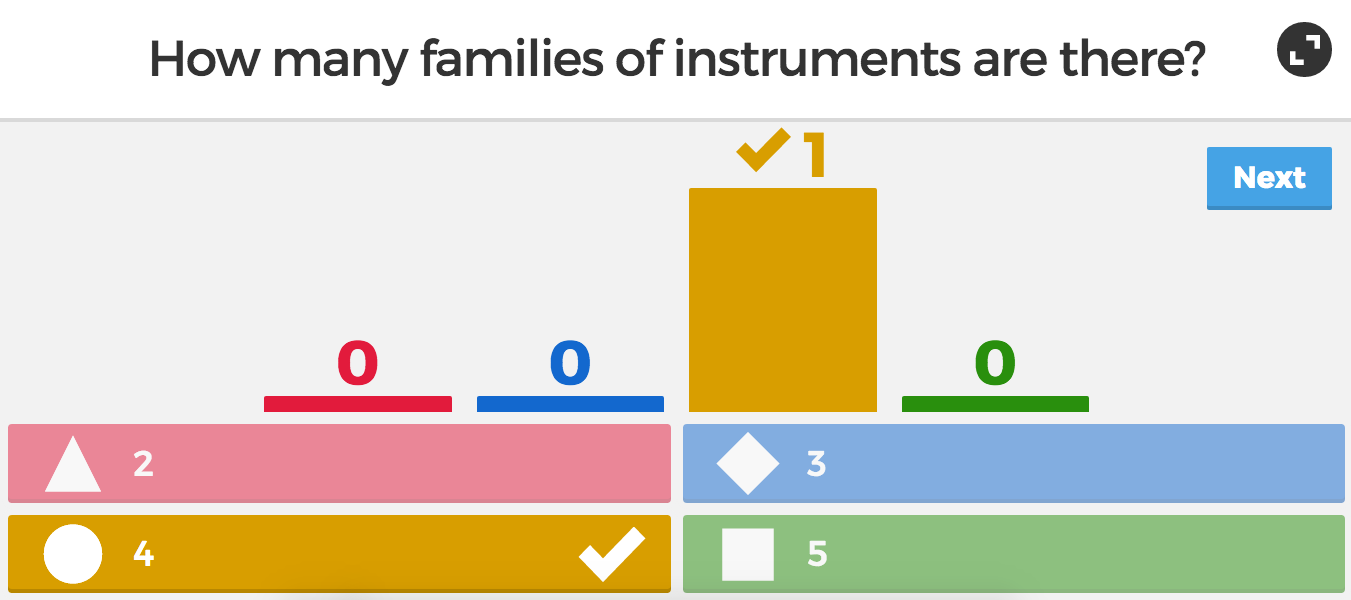
The first question will appear. Students will have several moments to read the question before the answers are displayed. Students select answers by choosing the corresponding shape or by color. The quicker a student responds with a correct answer, the more points they get. 


After the end of each round, the correct answer is displayed along with the amount of people that chose each answer. Following that, the leader board comes up, which encourages students in friendly competition.


How can I use Kahoot to assess students?
The most awesome feature of Kahoot might be it's ability to assess data. At the end of a game play, the teacher will reach a screen that gives the option to download the results. You have the option to download as an Excel file or download straight to Google Drive.


When you open the file, you get an analysis of how each student did overall and how they did on each question. A green mark indicates a correct answer, red indicates incorrect answer. You could use this data as a grade or as a way to inform your teaching.


Bottom line, students learn while having fun and you get the data you need to assess!

post signature

Thursday, August 20, 2015

Need a Pencil?

Monday, July 20, 2015

Job Search and Interview Tips for Music Teachers

Saturday, April 18, 2015

Your iPad's Camera App As An Assessment Tool

I would love to individually assess all of my students on rhythm reading. In reality, that isn't always possible during class because of limited time, shy students, and concert prep time among a million other things. Have access to iPads? The camera/video app can solve your assessment woes! You don't even need a whole class set for this to work!

Your iPad's camera app can serve as an easy assessment tool for your music classroom! You don't even need a full set for this to work.


During the 2nd quarter, I used my beginner Nutcracker rhythm composition kit with my 2nd graders. They were instructed to create a 4 beat pattern, read the rhythm using ta's/titi's/to-o, read the rhythm using the Nutcracker words, and then record themselves. 


Tips for Videos

1. After students have pressed record, make sure you have them pause briefly before saying anything. Sometimes kids start speaking before they are recording without realizing.
2. In order to identify which recording belongs to which student, have them say their first and last name as well as their homeroom/classroom teacher before they start whatever part they will say for the assessment.

3. If you choose to have students email their assessments to you, organize the video files by creating a folder for each classroom teacher.

4. Don't have access to a full set of iPads? Use it as part of centers activity!

Gathering Student Work
My school is fortunate enough to have a Google Drive folder for each child. Students uploaded their videos to their folders. I was able to go into their folders after school to assess their videos. If you don't have a Google Drive system set up at your school, don't fret! These videos are small enough to be emailed. Here's how:

1. Go to the camera roll and select the most recent video. Then tap on the icon that's in the bottom left side of the screen.

2. Select the video you want to send. The current video will come up already selected.


3. Select the send via mail option. The video will automatically compress once you tap the mail icon.


post signature

Sunday, April 12, 2015

Musical Opposites: Videos and Singing Games

Starting out lessons with a quick video is a great way to get students hooked on the day's lesson. Here are a few short videos to go along with singing games on musical opposite concepts high/low, fast/slow, and loud/soft.

High/Low

Videos:


Games:

Andy Pandy


Students march to steady beat and then freeze on high to reach as high as they can and low to touch their toes. Add another level by having students march in a circle.

Sigh High, Sing Low


Students stand in a circle and pass a dog (or other stuffed animal) to the student they call. In order to show who has had a turn, have students keep one hand on their head until the stuffed animal is passed to them. 

Fast/Slow

Videos:


Games:

Rig-A-Jig-Jig


This song is sung slowly until the fermata. After the fermata, the song picks up in tempo. I like to drag the first part out to really show contrast to the second part. To play the game, students sit in a circle. One student is chosen to walk slowly around the circle while students sing. When the class reaches the fermata, the student taps the shoulder of whoever is in front of them. The chosen student then chases the student around the circle and attempts to tag him/her before the song ends.

I do not have much room for chasing in my small music room so instead of having students running/chasing, I had both students gallop around the circle without trying to tag each other. They enjoyed it just as much without the competitive part.

Loud/Soft


Games:

Grizzly Bear


Students sit in a circle while one student(the sleeping grizzly bear) sits outside of the circle facing away from the rest of the group. One student in the circle is chosen to "wake" the grizzly bear by tapping the grizzly bear on the shoulder during the last two lines of the song (please be very quiet....). When students sing the word mad, the grizzly bear turns around and has three guesses to find who tapped them on the shoulder.

This post is a part of Fermata Fridays! Click above for other great music education posts.


post signature

Sunday, March 29, 2015

5 Children's Books About Women in Music

Incorporating literacy into music is an important part of my classroom. Celebrate Music in Our Schools Month and Women's History Month with these 5 books!

Incorporating literacy into your music classroom doesn't have to be tough! Celebrate women in music with these 5 children's books. Great to use for centers or when you have a few minutes at the end of class!


1. For the Love of Music: The Remarkable Story of Maria Anna Mozart by  Elizabeth Rusch
Many people know about Wolfgang Mozart but his sister is lesser known. This story tells of a brilliant pianist who toured along side her brother. The book is based on actual letters written within the Mozart family.


2. Skit-Scat Raggedy Cat Ella Fitzgerald by Roxanne Orgill

This wonderful story tells about Ella Fitzgerald's life from her childhood to her professional singing days. A great biography written for children so they can understand.


3. Clara Schumann: Piano Virtuoso by Susanna Reich

This book is more suitable for older children. It is a chapter book with 118 pages on Clara Schumann's musical life. The book includes diary entries and letters by Clara.

4. Little Piano Girl: The Story of Mary Lou Williams by Ann Ingalls and Maryann Macdonald

Just like Mozart, Mary Lou Williams began playing the piano very young and became a professional musician before she was a teenager. As a jazz pianist, she had the opportunity to arrange music for famous players such as Duke Ellington and Dizzy Gillespie. 


5. Harlem's Little Blackbird by Renee Watson

This story features Florence Mills, a lesser known singer from the 20s. Her singing and dancing dazzled audiences on broadway. 
post signature

Sunday, February 22, 2015

Put Your Old Wii to Work in You Music Classroom

Have an old Wii? Use it in your class through the game Wii Music! It's a fun treat for use in centers or as a full class review!

Boxshot: Wii Music by Nintendo of America

What You'll Need
Wii Console
1-4 Wii Controllers
1-4 Wii Nunchuck Controllers (some games can be played without it but some also require it)
Wii Music Game - purchase it used for under $5 from Amazon or Game Stop

Introduce the Activity: How to Play Wii Music

The lessons option can help you to introduce how Wii Music works to your students. Select Jam Basics to show students how to use the controllers.


What Games & Skills Does Wii Music Cover?

Jam Session
Select Custom Jam Session to let your students choose song, instruments, and venue. The band set up allows students to choose a bass, chord, percussion, melody, and harmony instrument. Instruments range from traditional such as violin and trumpet to world such as the sitar and castanets. Bouncing blobs at the bottom show students the steady beat, which can help reinforce playing in time/on the steady beat. At the end, students can watch their performance by selecting View Replay.


Pitch Perfect
This game is a great way to reinforce aural skills. A player is randomly selected to complete a challenge. These challenges include tasks like putting notes in order from high to low, finding the Mii who plays the same pitch as the given pitch(picture below), finding the instrument(out of a group of 4 instruments) who made a mistake in the music, picking the group that sings "like a sunny day" (major vs minor), and many more. Players earn points by selecting the correct answer. The quicker they find the answer, the more points they earn. This game can be used as a whole class review in single player mode.


Mii Maestro
This game allows players to become orchestra conductors. The Wii controller becomes the baton. When more than one controller is involved in this mini game, the object is to conduct at the same time. This game can be used to reinforce steady beat and give students a chance to experience what it's like to be in front of an orchestra. At the conclusion of the game, a score is given on how accurate the conductors were. I will warn you, the multiplayer aspect of this game is more difficult than you'd think! 


Handbell Harmony
Use the Wii controller and nunchuck to form a handbell choir! Follow the colored handbells on the screen, which tell when you should play. This game can be used to reinforce playing rhythms in time. One trick I've found is you should try to play your handbell slightly before it gets to the yellow strip. 


post signature